
- India,
- 11-Oct-2026 07:40 AM IST



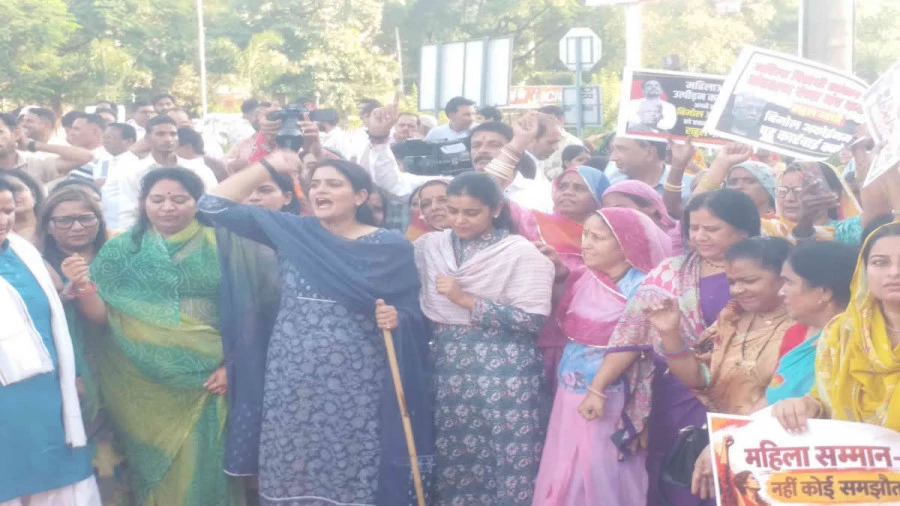
Political tensions in Rajasthan escalated on Saturday as the BJP Mahila Morcha organized a massive protest in Jaipur regarding the alleged sexual harassment case involving students of Jawaharlal Nehru University (JNU), while the protest saw a large number of women leaders and workers from the Bharatiya Janata Party (BJP) taking to the streets to express their outrage. The demonstrators marched from the BJP state office with the intention of gheraoing the Congress state headquarters. However, the situation became tense when the police intercepted the protesters at Chomu House Circle, leading to a significant scuffle between the police personnel and the BJP women leaders.
Demands for Arrest and Capital Punishment
The protesting women leaders were seen carrying posters and placards with slogans against the Congress party and its leadership, while a primary demand raised during the demonstration was the immediate arrest of Congress Member of Parliament (MP) Dr. Angomcha Bimol Akoijam, who has been linked to the allegations. The protesters raised loud slogans demanding the death penalty for the accused, emphasizing that such heinous acts against students in educational institutions can't be tolerated. The BJP Mahila Morcha linked the JNU incident to the broader issue of women's safety, the dignity of female students, and the accountability of the Congress leadership.
Rakhi Rathore Questions Congress Leadership
Rakhi Rathore, the State President of BJP Mahila Morcha, spearheaded the attack on the Congress party. She pointed out that while Rahul Gandhi frequently speaks about women's rights and dignity from public platforms, his party remains silent when its own MP is facing such serious allegations. Rathore stated that the issue of women's respect shouldn't be limited to political speeches but must be reflected in the party's accountability. She demanded that the Congress party clarify its stance on the matter and ensure that the victimized students receive justice. On top of that, she stressed the importance of protecting the identity and privacy of the students involved, asserting that no individual should be considered above the law regardless of their political influence.
Manju Sharma on Safety in Educational Institutions
Jaipur MP Manju Sharma also joined the protest and emphasized that the allegations involving JNU students must be taken with utmost seriousness. She remarked that this isn't merely a matter of political mudslinging but a fundamental question regarding the safety of female students in educational institutions and the impartiality of the redressal mechanisms, while sharma questioned the Congress leadership's position on justice for the students and insisted that the investigation process must remain fair and transparent while safeguarding the privacy of the complainants. She reiterated that the law must be equal for everyone and influential positions shouldn't provide a shield against legal action.
Focus on Privacy and Dignity
Suman Sharma, the former Chairperson of the Rajasthan State Commission for Women, highlighted the sensitivity required in handling cases of sexual harassment. She stated that the safety, privacy, and dignity of the complainants must be the top priority during any investigation. According to her, the facts and findings of the probe should be presented responsibly to ensure that the students don't face any social or mental pressure. She urged that the case be viewed through the lens of students' rights and justice rather than through a purely political prism, ensuring that all legal procedures are followed strictly and impartially.
Allegations of Double Standards
BJP State Spokesperson Manisha Singh launched a scathing attack on the Congress, accusing the party of exhibiting a double character. She questioned whether Rahul Gandhi would continue to keep a leader in his party who is accused of such a "disgusting act" against innocent girls. Singh remarked that a teacher's role is to guide, but in this case, the sacred relationship between a teacher and a student has been tarnished. She demanded the immediate arrest of the accused and the harshest possible punishment. Singh concluded by stating that women's safety must be visible in behavior and accountability, not just in political rhetoric, and called for an investigation free from any external pressure.