

- India,
- 13-Feb-2026 08:19 PM IST


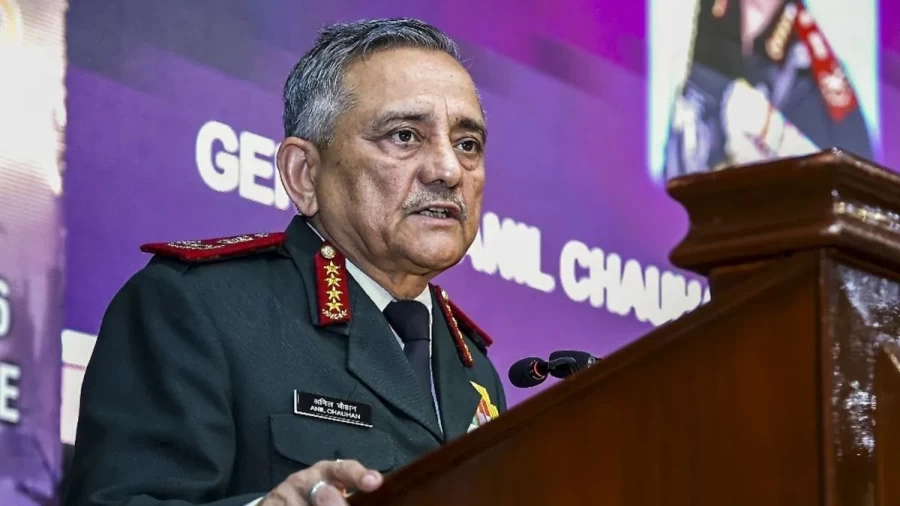
Chief of Defence Staff (CDS) General Anil Chauhan has shared significant insights into the historical trajectory of India-China relations and the 1954 Panchsheel Agreement. Speaking at the 'Himalayan Strategy Forum' held at Lok Bhavan in Dehradun, General Chauhan detailed the circumstances under which India recognized Tibet as part of China. According to the CDS, the agreement was primarily aimed at maintaining stability between the two nations and was driven by the intention to develop cooperative relations during the early years of India's independence, while he noted that the decision was a strategic move to address the geopolitical realities of that era.
General Chauhan emphasized that following the end of British rule in 1947, the responsibility of determining the nation's borders rested with the Indian leadership. Referring to the historical context, he stated that while Prime Minister Jawaharlal Nehru had the McMahon Line in the East and claims in Ladakh as a basis, the situation on the ground lacked complete clarity. This ambiguity, coupled with the need for regional peace, led India to choose the path of the Panchsheel Agreement as a diplomatic framework to manage its northern frontiers.
China's Strategic Expansion in Tibet and Xinjiang
General Anil Chauhan pointed out that by the early 1950s, China's strategic positioning was evolving rapidly. China had entered Tibet and established its presence from Xinjiang to Lhasa, while according to the CDS, this entire region was extremely sensitive from a security perspective. China's expansion into these areas created a new strategic environment for India. Both nations at that time sought to avoid major conflicts and prioritized regional stability, while this necessity for a stable environment in the high-altitude regions played a crucial role in bringing both countries to the negotiating table for the 1954 pact.
The 1954 Panchsheel Agreement and Regional Stability
The Panchsheel Agreement, signed in 1954, was a landmark document in bilateral relations. General Chauhan mentioned that under this agreement, India formally accepted Tibet as a region of China. The rationale behind this decision was the belief that it would stabilize a major portion of India's northern border. According to officials, it was assumed at the time that most of the northern boundary had been settled, except for those specific areas that had not been finalized through formal treaties. The agreement was based on five principles of peaceful coexistence, intended to reduce friction between the two Asian giants.
Defining the Distinction Between Border and Frontier
During his address, General Chauhan also elaborated on the conceptual differences between a 'Border' and a 'Frontier'. He explained that a border is a clear political and legal line marked on maps and on the ground. In contrast, a frontier is a broad and blurred zone shaped by centuries of customs, historical contacts, and traditions. According to the CDS, while a border separates two sovereign nations, a frontier serves as a meeting point for two different civilizations. He noted that the Himalayan region has historically transitioned from being a frontier to having defined borders.
Historical Context of India's Northern Boundary Claims
The CDS further explained that India's northern boundary claims have been rooted in historical treaties and customary practices, while after 1954, the Indian administration operated under the assumption that its borders were largely defined and secure. However, he indicated that the lack of formal treaties in certain sectors eventually led to complexities, while general Chauhan stated that understanding this history is vital for addressing contemporary security challenges. His remarks at the Himalayan Strategy Forum provide a detailed perspective on how past diplomatic decisions continue to influence the strategic landscape of the Himalayan region today.
