

- India,
- 09-Nov-2025 09:07 AM IST


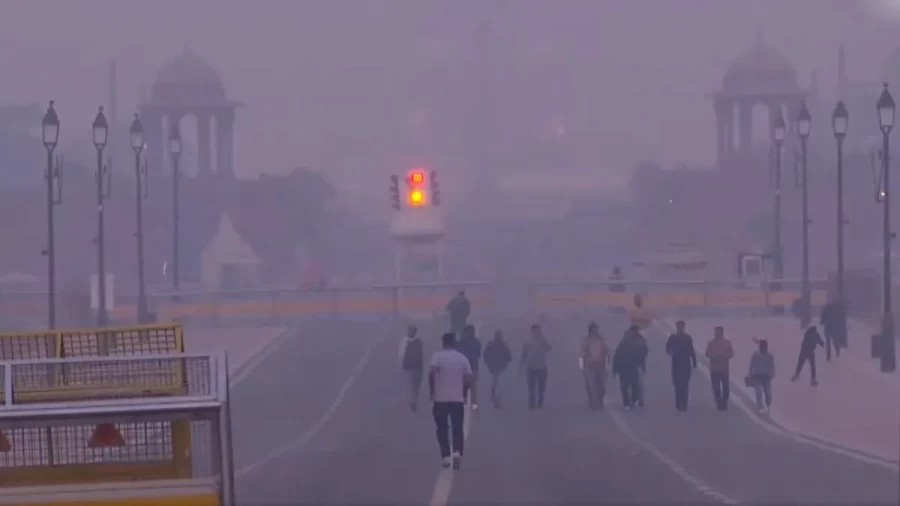
Residents of Delhi and the National Capital Region (NCR) are currently facing a dual challenge as the region experiences both a noticeable drop in temperatures and a significant increase in air pollution levels, while the onset of colder weather is becoming more apparent, particularly during the night and morning hours, with the meteorological department forecasting a further dip in temperatures in the coming days. This intensifying cold coincides with an alarming rise in air pollution, with the Air Quality Index. (AQI) in several parts of Delhi-NCR soaring past the 400 mark, categorizing the air quality as 'severe'.
Worsening Air Quality Situation
According to the latest data from the Central Pollution Control Board (CPCB), the air quality in the national capital reached the 'severe' category on Sunday. At 7 AM, the average AQI for Delhi was recorded at 392, placing it at the higher end of the 'very poor' category and on the brink of 'severe'. Neighboring cities in the NCR also reported concerning levels, with Noida's AQI at 391 and Ghaziabad's at 387, both firmly in the 'very poor' category and nearing 'severe'. This widespread deterioration indicates a persistent and escalating air quality crisis across the entire NCR, posing significant health risks to its inhabitants.
Trend Over Days and GRAP-2 Implementation
Several areas within Delhi have registered dangerously high Air Quality Index readings. CPCB data indicates that Anand Vihar recorded an AQI of 412, Alipur 415, Ashok Vihar 416, and Bawana the highest at 436. All these figures fall squarely into the 'severe' category, signifying extremely poor air quality. Also, Chandni Chowk registered an AQI of 409, while RK Puram and Patparganj recorded 422 and 425 respectively. Sonia Vihar also saw a 'severe' AQI of 415, with ITO at 420, Mundka at 412, Okhla at 405, and PUSA at 406, while these statistics clearly illustrate that breathable air is scarce in most major areas of Delhi, potentially leading to serious health complications for the population. The air quality in Delhi-NCR has been consistently poor over the past few days. On Saturday, the national capital's air quality remained in the 'very poor' category, with an AQI of 355 recorded by 8 AM. The day before, on Friday, the capital's AQI had already entered the 'very poor' category at 312. Since Diwali, the AQI in many areas of Delhi-NCR has fluctuated between 'poor' and 'very poor' categories, indicating a sustained period of high pollution levels, while despite this deteriorating situation, Stage 2 of the Graded Response Action Plan (GRAP) remains in effect, aiming to mitigate air pollution.
Measures Under GRAP-2
Following the implementation of GRAP-2 due to the worsening air quality, the New Delhi. Municipal Council (NDMC) had already announced a doubling of parking fees across the national capital. This measure is intended to discourage the use of private vehicles and encourage greater reliance on public transport, thereby reducing vehicular emissions, which are a significant contributor to air pollution, while different stages of GRAP entail various restrictions and measures based on the air quality levels, and increasing parking fees under Stage 2 is a key step in this comprehensive plan.
Understanding AQI Categories
The Central Pollution Control Board (CPCB) categorizes the Air Quality Index (AQI) into different bands to help the public understand air quality levels and their associated health impacts. An AQI between 0 and 50 is considered 'Good', posing minimal health risks. 51-100 is 'Satisfactory', with minor concerns for sensitive individuals, while 101-200 is 'Moderate', where sensitive people may experience health problems. 201-300 is 'Poor', which can cause health issues for most people, while 301-400 is 'Very Poor', potentially leading to severe health impacts. Finally, 401-500 is classified as 'Severe', which can affect even healthy individuals and is extremely dangerous for those with existing illnesses. The fact that AQI in many parts of Delhi-NCR has exceeded 400 is a clear indication that the air quality in the region has reached extremely hazardous levels, necessitating immediate and effective intervention to protect public health.
