

- India,
- 03-Nov-2025 08:04 AM IST


The national capital, Delhi, continues to grapple with a severe air pollution crisis, rendering its air toxic and hazardous for residents. On Monday, the Air Quality Index (AQI) across various parts of Delhi remained in the 'very poor' category, escalating health concerns for the city's inhabitants, while according to data released by the Central Pollution Control Board (CPCB), Delhi's overall AQI on Monday was recorded at 324, which is classified as 'very poor'. This status indicates that the concentration of pollutants in the. Air is alarmingly high, posing significant risks, especially to vulnerable populations.
Current AQI Status Across Key Localities
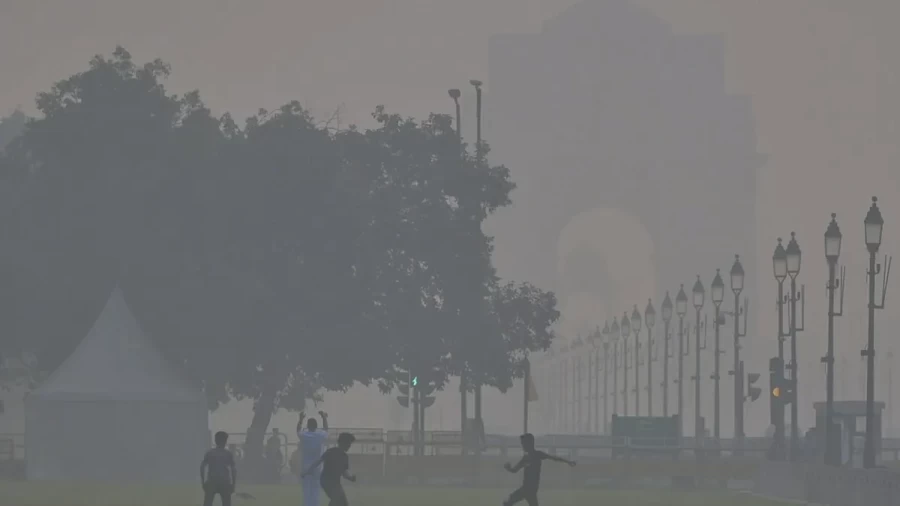
Air pollution levels varied across different regions of Delhi, yet the air quality in most major areas remained a cause for serious concern, while as per CPCB data, the AQI in Akshardham and its surrounding areas was recorded at 347, placing it firmly in the 'very poor' category. Similarly, the All India Institute of Medical Sciences (AIIMS) and its vicinity also registered an AQI of 342, which is also considered 'very poor'. Anand Vihar presented an even more critical situation, where a thick blanket of fog enveloped the area, pushing the AQI to a staggering 371, again categorized as 'very poor'. India Gate experienced dense fog on Monday morning, leading to reduced visibility. The AQI for this area was 247, falling into the 'poor' category. These figures collectively highlight that the air in most parts of Delhi is unfit for breathing, necessitating extreme caution from residents.
Detailed Explanation of AQI Categories
The Air Quality Index (AQI) is categorized into different levels. To help the public easily understand the severity of air quality. An AQI between 0 and 50 is considered 'good', signifying clean and safe air. An AQI from 51 to 100 falls into the 'satisfactory' category, where sensitive individuals might experience minor breathing discomfort. The 'moderate' category, ranging from 101 to 200, suggests that people with lung diseases, heart diseases, or the elderly may experience breathing difficulties. An AQI between 201 and 300 is deemed 'poor', potentially causing breathing discomfort to people with prolonged exposure to respiratory illnesses. The 'very poor' category, from 301 to 400, can lead to respiratory illness on prolonged exposure and may cause significant health impacts on people with heart disease. Finally, the 'severe' category, with an AQI between 401 and 500, can affect healthy people and seriously impact those with existing diseases. Delhi's current situation oscillates between 'very poor' and 'poor' categories, which is a matter of grave concern.
Air Quality Forecast for the Coming Days
The Centre's Air Quality Early Warning System (EWS) has issued a troubling forecast regarding Delhi's air quality for the upcoming days. According to the prediction, Delhi's air is expected to remain in the 'very poor' category through Monday. However, the situation is projected to worsen Notably on Tuesday, when the AQI is anticipated to reach the 'severe' category. A 'severe' AQI implies that the index will rise above 400, creating serious health risks, particularly for children, the elderly, and individuals with respiratory problems. Following this, a slight improvement in air quality is expected on Wednesday, but it will still remain in the 'very poor' category. This forecast serves as a critical warning to Delhi residents, urging them to exercise extra caution in the coming days and avoid unnecessary outdoor exposure.
AQI Trends Over the Past Few Days in Delhi
Delhi's air pollution levels have shown continuous fluctuations over the past few days, but the overall trend points towards deteriorating air quality. On October 30, Delhi's AQI was recorded at 373, which was in the 'very poor' category, while there was a slight improvement on October 31, when it dropped to 218, placing it in the 'poor' category. However, this improvement was short-lived. On November 1, the AQI rose again to 303, returning to the 'very poor' category. Subsequently, on November 2, the situation further deteriorated, with the AQI recorded at 366, consistently remaining in the 'very poor' category. This data indicates that Delhi's air continues to be at hazardous levels, with no sustained improvement in sight.
Delhi's Weather Conditions and Their Impact on Pollution
Weather conditions play a crucial role in exacerbating Delhi's air pollution, while the Meteorological Department has predicted light fog in the capital on Monday. The maximum temperature is expected to be around 30 degrees Celsius, with the minimum temperature hovering around 15 degrees Celsius, while fog and lower temperatures often trap pollutants closer to the ground, leading to a further deterioration in air quality. Previously, on Sunday, Delhi's maximum temperature was recorded at 30. 7 degrees Celsius, which was 0, while 5 degrees below the seasonal average, while the minimum temperature was 16. 8 degrees Celsius, 1. 5 degrees above normal. These changes in weather, particularly the drop in temperature and the presence of fog, prevent pollutant particles from dispersing into the atmosphere, thereby contributing to the rise in AQI and making Delhi's air even more toxic. Residents are advised to check the AQI before stepping out and take necessary precautions.
#WATCH दिल्ली: आनंद विहार में कोहरे की मोटी चादर छाई, AQI बिगड़कर 371 पर पहुंचा, केंद्रीय प्रदूषण नियंत्रण बोर्ड (CPCB) ने इसे 'बहुत खराब' श्रेणी में रखा। pic.twitter.com/WpUVxODp2X
— ANI_HindiNews (@AHindinews) November 3, 2025
