

- India,
- 05-Sep-2025 04:40 PM IST


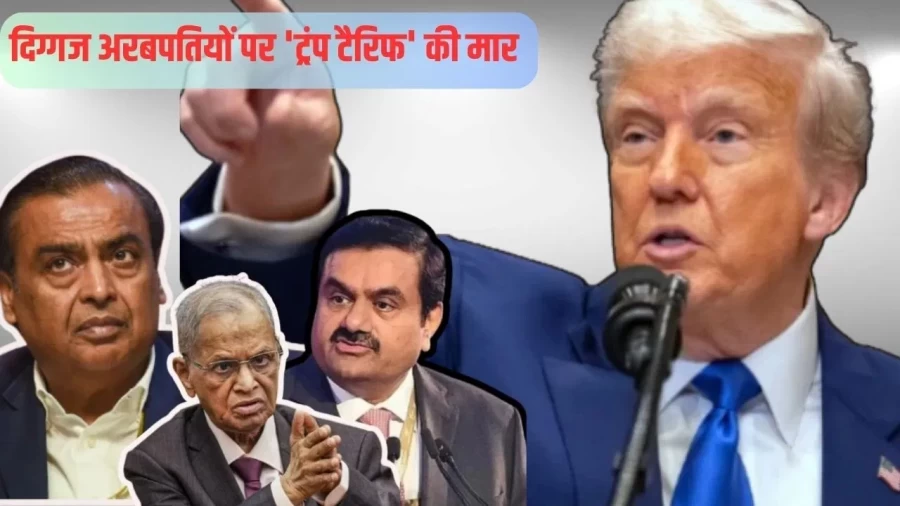
India-US Tariff War: The 50% tariff imposed on India by US President Donald Trump has created a stir in global trade. This policy is not only affecting India-US trade relations, but is also having a direct impact on some of the country's biggest and most influential businessmen, such as Mukesh Ambani, Gautam Adani, Narayana Murthy, and Lakshmi Mittal. Apart from this, sectors like textiles, automotive, and electronics are also facing serious challenges. This article analyzes the impact of this tariff, its impact on Indian companies, and strategies to deal with it.
Impact on major companies
Reliance Industries (Mukesh Ambani)
Mukesh Ambani's Reliance Industries Limited (RIL) is one of India's largest companies, with 45% of its revenue coming from exports. According to a Bloomberg report, RIL bought 142 million barrels of crude oil from Russia in the first six months of 2025, saving the company about $571 million. However, its exports may be hit hard due to US tariffs. RIL's energy and digital projects, which include giants like Google, Meta, and Disney, may also be affected. The company is now working on a strategy to look for alternative markets and reduce production costs.
Adani Group (Gautam Adani)
Gautam Adani's Adani Ports, India's largest port company, plays a key role in the country's foreign trade with a 27% market share. According to Bloomberg Intelligence analyst Sharon Chen, Adani Ports' business will be most affected by the reduction in foreign trade due to tariffs. Apart from this, Adani Group's solar panels, which are exported to the US, are also hit by this tariff. The US is the largest buyer of India's solar modules, and tariffs could cause huge losses to this sector. The Adani Group is now focusing on alternative markets like Southeast Asia and Europe.
Infosys (Narayana Murthy)
Infosys, whose co-founder is Narayana Murthy, was also not untouched by this tariff. "We are going through a difficult phase. The best way to get out of this is to make products that are important to customers, so that they are willing to pay the extra cost," Deepak Padaki, president of Infosys' family office Catamaran Ventures, told Bloomberg. The IT sector, which is heavily dependent on the US market, may face cost increases and a loss of competitiveness due to tariffs.
ArcelorMittal (Lakshmi Mittal)
Lakshmi Mittal's ArcelorMittal, which exports $6.7 billion worth of steel to the US in 2024, expects a profit loss of $150 million due to the tariffs. The company is now adopting a strategy to increase its manufacturing operations in the US itself to reduce the impact of tariffs. This strategy will not only control costs but will also boost local employment.
Royal Enfield (Eicher Motors)
Royal Enfield's motorcycles are quite popular in the US market, but tariffs are expected to lead to a price hike and a drop in sales. The company is now planning to open warehouses in Canada to maintain its presence in the US market. This strategy may help mitigate the impact of tariffs.
Other affected sectors
Textiles and home textiles
The textile and home textiles sector is being deeply affected by tariffs. Welspun Living, which derives 61% of its revenue from the US, is facing huge challenges. The US has increased tariffs on Indian textiles from 12% to 62%, reducing the competitiveness of Indian products. As a result, orders may shift to countries such as Bangladesh and Vietnam.
Automotive and electronics
Companies such as Bharat Forge, which exported goods worth $200 million to the US last year, and Motherson Group are also being affected. Tariffs on copper have become a major problem for Polycab, as it is increasing their production costs. In the automotive sector, 27% of India's total auto component exports go to the US, and jobs in this sector are also at risk due to tariffs.
Shrimp and jewellery
The imposition of a 60% tariff on shrimp exports, which account for 66% of India's seafood exports, could impact orders worth $2.4 billion. Similarly, the jewellery and gems sector, especially in Surat and Mumbai, is expected to see a hit in exports worth $10 billion.
India's strategy and future direction
The Indian government and businesses are taking several steps to deal with this challenge. Union Commerce Minister Piyush Goyal has ruled out retaliatory tariffs but has promised to protect exporters and jobs through policy, fiscal, and diplomatic measures. India is embarking on a Rs 25,000 crore export promotion mission with an emphasis on exploring new markets and reducing production costs.
Companies are also looking at alternative markets, such as Europe, Southeast Asia, and the Middle East. For instance, jewellery exporters are planning to set up new manufacturing bases in Dubai and Mexico, where tariffs are lower.
