
- India,
- 24-Sep-2026 12:54 PM IST



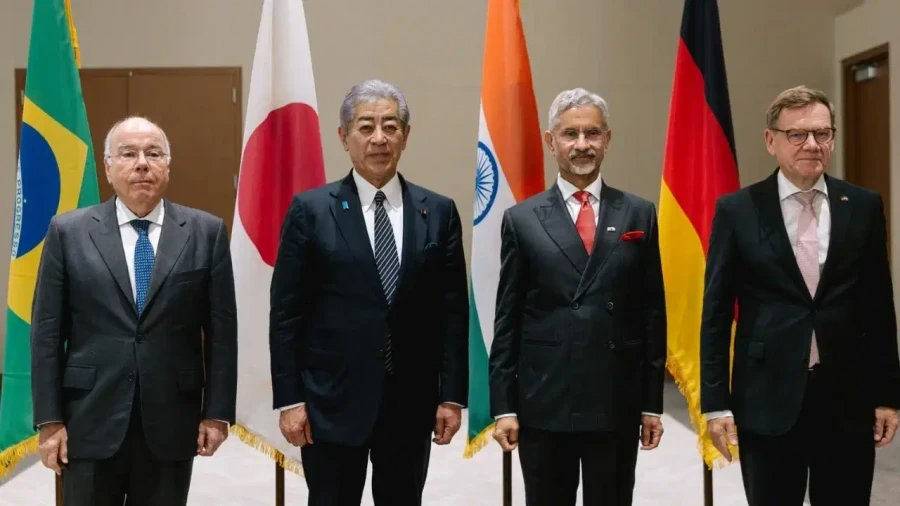
The G4 nations, comprising India, Brazil, Germany, and Japan, have collectively voiced a strong demand for the immediate reform of the United Nations Security Council (UNSC). During a high level meeting held on the sidelines of the 81st session of the United Nations General Assembly (UNGA) in New York, the foreign ministers of these four influential countries emphasized that the current structure of the council is outdated and fails to reflect the contemporary geopolitical landscape. The ministers highlighted that the 80 year old framework of the UNSC has become a primary obstacle in addressing modern global challenges, rendering the body increasingly ineffective in its core mission of maintaining international peace and security.
High Level Representation and Strategic Deliberations
The meeting saw the participation of prominent diplomatic figures, including Brazil Foreign Minister Mauro Vieira, Germany Foreign Minister Dr. Johann David Wadephul, India External Affairs Minister Dr, while s. Jaishankar, and Japan Foreign Minister Motegi Toshimitsu. These leaders reviewed the discussions that took place during the 80th UNGA session under the framework of the Intergovernmental Negotiations (IGN) on Security Council reform. The ministers engaged in a comprehensive dialogue regarding the prospects for reform and the current status of the council, concluding that the status quo is no longer sustainable, while they argued that the council's representation, legitimacy, credibility, and overall effectiveness are being questioned by the majority of the international community.
The Call for Structural Expansion
A central theme of the G4's demand is the expansion of the Security Council in both the permanent and non-permanent categories of membership. The G4 ministers asserted that such an expansion is crucial to ensure that the council remains relevant in a rapidly changing world. They pointed out that the current 80 year old structure reflects a post World War II era that doesn't align with today's realities. According to the G4, the majority of UN member states support this stance, yet their voices are being ignored. The ministers stressed that the lack of representation for key regions is a significant flaw that must be rectified to restore the council's authority.
Focus on Underrepresented Regions
The G4 nations specifically called for increased participation from regions that are currently underrepresented or entirely excluded from the council's decision making processes. This includes Africa, the Asia-Pacific, and Latin America and the Caribbean. The ministers welcomed the UNSC reform model presented by the African Group during the 80th UNGA session within the IGN framework. They emphasized that countries that contribute Importantly to the maintenance of international peace and security should have a greater role in the council. The G4 reiterated that the inclusion of these regions isn't just a matter of fairness but a necessity for the council's effectiveness in handling future security threats.
Criticism of the 18 Year IGN Process
The ministers expressed deep concern over the lack of progress in the Intergovernmental Negotiations (IGN) process, which has been ongoing for 18 years. They questioned the effectiveness of this long standing process and criticized the slow pace of change. The G4 argued that the requirement for consensus shouldn't be used as a tool to block progress, citing the UN Charter and the IGN mandate. They suggested that discussions on UNSC reform shouldn't be confined solely to the IGN framework if it continues to yield no results. The four nations reaffirmed their commitment as democratic states with the proven capacity and willingness to contribute to the UNSC's primary responsibility of global peace.
Next Steps and the New Delhi Review
Following the intense deliberations in New York, the G4 nations have decided to move the next phase of their strategic review to New Delhi. The upcoming meeting in the Indian capital will serve as a platform to further analyze the progress of these discussions and refine their collective strategy for pushing the reform agenda forward. The ministers concluded that the urgency of the situation can't be overstated, as the current geopolitical tensions make a reformed and effective Security Council more necessary than ever before. The world will be watching closely as India, Brazil, Germany, and Japan continue their joint efforts to reshape the pinnacle of global governance.