
- India,
- 08-Aug-2026 08:39 AM IST



Iran has officially reacted with significant skepticism and criticism toward the recently concluded defense agreement between Saudi Arabia, Pakistan, and Turkey. The Iranian government has characterized this tripartite security pact as a superficial arrangement, asserting that such paper agreements are incapable of providing Saudi Arabia with the permanent security it seeks, while this reaction highlights the regional tensions and the differing perspectives on collective security frameworks in the Middle East and South Asia.
Iranian Official Criticizes the Tripartite Pact
Ebrahim Razai, a prominent member of the Iranian Parliament's National Security and Foreign Policy Commission, has been vocal about Iran's stance on this new development. Razai explicitly stated that any security agreement involving Pakistan and Turkey would fail to serve as a guarantee for Saudi Arabia's long-term security. In a statement shared on the social media platform X, Razai noted that Saudi Arabia must understand that a mere paper agreement with Turkey and Pakistan won't grant them the security they desire, while he drew a parallel to Saudi Arabia's historical reliance on the United States, suggesting that just as years of unilateral dependence on American support failed to provide them with absolute security, this new regional pact would also fall short. Plus, Razai claimed that if Saudi Arabia were to fundamentally improve its own policies and strategic approach, it wouldn't find itself in a position where it has to beg other nations for its security needs.
Details of the Mecca Joint Defense Agreement
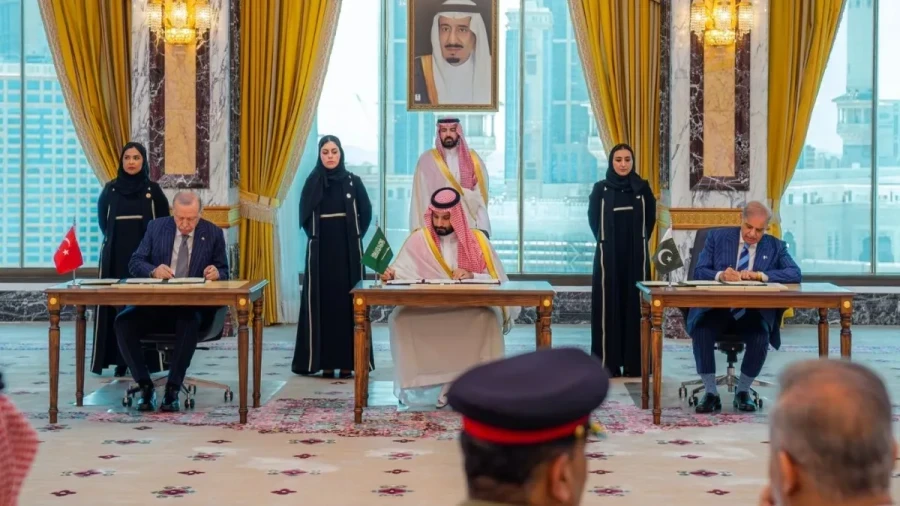
The agreement in question is the historic Mecca Joint Defense Agreement, which was signed by Saudi Arabia, Pakistan, and Turkey in the holy city of Mecca. The core of this defense deal is a collective security clause which stipulates that an armed attack on any one of the three signatory nations will be considered an attack on all three. This provision is designed to Notably strengthen the collective defense capabilities and the overall deterrence potential of the participating countries. The signing ceremony took place at the Al-Safa Palace in Mecca, involving high-level leadership from all three nations. The signatories included Pakistan's Prime Minister Shehbaz Sharif, Saudi Arabia's Crown Prince Mohammed bin Salman, and Turkey's President Recep Tayyip Erdogan. During their meeting at the palace, the leaders formalized the agreement, which has been described by a Turkish government official as being entirely defensive in nature. The official emphasized that the parties have committed to supporting each other specifically within the realm of defense.
The Joint Statement and Strategic Objectives
Following the signing, a joint statement was issued which elaborated on the motivations behind the Mecca Joint Defense Agreement. The statement noted that the pact is inspired by the long-standing historical relations that exist between the three nations. It's built upon the strong bonds of brotherhood and Islamic solidarity that unite them. The agreement aims to further their shared strategic interests and build upon their existing long-term defense cooperation. For its part, Saudi Arabia has sought to clarify the scope and intent of the agreement. Saudi officials have stated that this pact doesn't represent the beginning of a new military alliance or a bloc formed on religious grounds. Instead, the primary objective is to enhance mutual cooperation and strengthen defense capabilities. Saudi Arabia also clarified that the agreement isn't related to any nuclear activities or an arms race. Also, the kingdom emphasized that this new deal won't negatively impact Saudi Arabia's existing strategic relationships with other nations.
Comparisons with the NATO Alliance
The Mecca Joint Defense Agreement has drawn immediate comparisons to the North Atlantic Treaty Organization (NATO). This comparison stems from the collective security principle embedded in the deal, which mirrors NATO's Article 5. In the NATO framework, an attack against one member state is considered an attack against all members, requiring a collective response. By adopting a similar clause, Saudi Arabia, Pakistan, and Turkey have established a framework where they're committed to fighting together if any one of them faces armed aggression. This move is seen as part of Saudi Arabia's broader strategy to diversify its defense partnerships and reduce its singular reliance on traditional Western allies.