
- India,
- 18-Oct-2026 05:36 PM IST



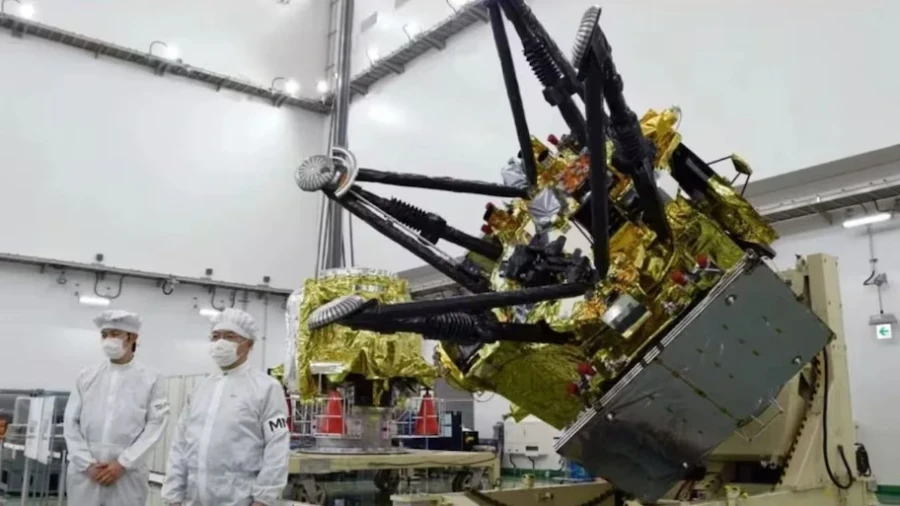
Japan is currently preparing for a new and massive space mission that could prove to be a historic milestone in the annals of space exploration. Japan is actively considering launching the historic Martian Moons Exploration, known as MMX mission, in the near future to retrieve precious samples from Mars' moon Phobos, while according to official information released from the space sector, the H3 rocket of the Japan Aerospace Exploration Agency, commonly referred to as JAXA, is scheduled to lift off on October 20 from the Tanegashima Space Center. This landmark undertaking will mark the first-ever round-trip mission to the Martian system in human history, opening unprecedented doors in the field of space research.
Under the framework of this comprehensive plan, the robotic probe will reach Mars after a journey lasting about one year and will orbit Phobos for a duration of 3 years. During this operational phase, the spacecraft will collect a minimum of 10 grams of soil and subsequently return safely to Earth in the year 2031. The primary objective of this highly ambitious mission is to unraveling the deepest mysteries surrounding the origin of our solar system and the genesis of life. Plus, this unmanned mission, officially designated as MMX, isn't merely a solo Japanese endeavor but a collaborative joint effort involving space agencies from the United States and Europe, alongside numerous universities and advanced technological companies. This mission is also expected to lay a solid foundational groundwork for future human exploration of Mars.
Official Statements from the Japan Aerospace Exploration Agency
According to official announcements made by the Japan Aerospace Exploration Agency, the primary H3 rocket carrying the MMX payload will lift off from the Tanegashima Space Center on Tuesday morning at 4:41 AM, which corresponds to 01:11 AM according to Indian Standard Time. As part of this intricate expedition, a specialized rover named Idefix—which derives its name from the French moniker of the canine companion belonging to the famous comic book hero Asterix—will conduct an initial surface inspection to guarantee a safe landing for the main spacecraft. Notably, acquiring physical samples directly from Phobos represents a pioneering world-first endeavor that has generated immense excitement among scientists globally.
What is the Core Objective of This Historic Mission?
JAXA has explicitly stated that the mission will thoroughly explore the possibilities of utilizing Phobos as a natural space station. To achieve this, the precise logistical and operational requirements for a round-trip journey to Mars will be evaluated, which is deemed absolutely critical for executing crewed missions to the Red Planet. Before initiating its return trajectory toward Earth, the spacecraft will also conduct close-range observations of Mars' second moon, Deimos, although it won't make a physical landing on that celestial body.
JAXA harbors strong expectations that this mission will conclusively reveal how Mars and its two companion moons originally formed. Such invaluable data could serve as a vital missing link in fully comprehending the formation of our entire solar system, while regarding the birth of the Martian moons, one leading scientific hypothesis is the giant impact theory. According to this premise, these moons were forged when a massive celestial body collided violently with Mars in the distant past.
New Collaborative Efforts with International Space Agencies
On the other hand, the competing capture hypothesis suggests that these moons were originally independent asteroids that were subsequently ensnared by the gravitational pull of Mars. Highlighting the four rocky terrestrial planets situated closest to the Sun—namely Mercury, Venus, Earth, and Mars—JAXA noted that determining which of these theories is accurate will help illuminate how habitable environments capable of supporting life emerged on terrestrial worlds.
It's worth highlighting that the MMX mission represents a collaborative cooperative effort involving France's National Center for Space Studies, known as CNES, the German Aerospace Center, known as DLR, NASA, the European Space Agency, known as ESA, and roughly 20 universities and technological corporations worldwide. According to JAXA scientists, engineering and developing the landing legs for this spacecraft proved to be an exceptionally difficult challenge due to the extremely weak gravitational pull present on Phobos.
In this context, it's also notable that Japan's previous unmanned Smart Lander for Investigating Moon, popularly referred to as the Moon Sniper, unfortunately tipped over after successfully touching down on Earth's moon in 2024. Despite this setback, that lander continued transmitting crucial scientific data and remained fully functional and secure through multiple freezing two-week-long lunar nights, thereby boosting the morale of Japanese researchers Importantly.