
- India,
- 26-Nov-2026 12:39 PM IST



Amidst the rapidly growing influence of China in the Pacific Ocean, Australia has taken a massive strategic step by signing a crucial security agreement with the Solomon Islands, a small island nation with a population of about 800,000 people. This new arrangement makes Australia the primary security partner of the island nation, dealing a severe blow to Beijing. This development is particularly notable because just four years ago, in 2022, the Solomon Islands had signed a similar security pact with China. Consequently, this new deal is being viewed as a major setback for China's regional ambitions, reshaping diplomatic equations in the Indo-Pacific.
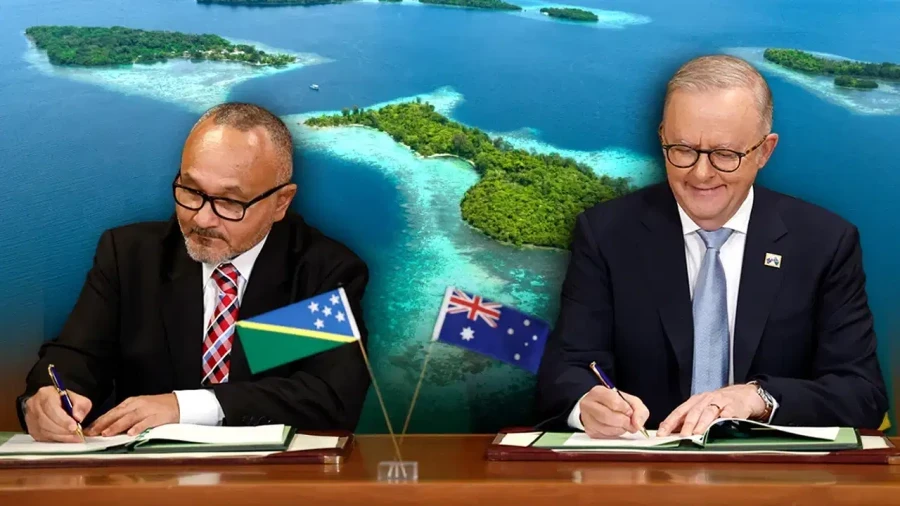
Last Wednesday, during an important event in the Australian capital of Canberra, Australian Prime Minister Anthony Albanese and Solomon Islands Prime Minister Matthew Wale officially signed this historic agreement. Under the primary provisions of this pact, Australia will provide extensive assistance to strengthen the police and border security forces of the Solomon Islands. In a significant move, the Solomon Islands has also agreed not to permit any foreign nation to establish military or security bases within its sovereign territory, a clause explicitly aimed at curbing foreign military encroachment in the region.
This comprehensive agreement encompasses not only defense and security but also strong economic cooperation. Australia will fund infrastructure and educational development in the Solomon Islands. On top of that, the treaty includes provisions to ease visa arrangements for local citizens and to seek consultation from Australia on crucial infrastructure decisions. Notably, Australia has previously entered into similar security cooperation agreements with other Pacific nations such as Papua New Guinea, Vanuatu, and Fiji.
Controversial 2022 Security Deal With China
The Solomon Islands entered into a security agreement with China back in 2022, which had sparked widespread international concern at the time. Western nations, particularly Australia and the United States, expressed deep apprehension that Beijing could benefit from this pact to project military power and expand its naval presence in the sensitive Pacific region, while under that Chinese arrangement, Beijing could play a pivotal role in police training, maintaining law and order, and providing security assistance whenever deemed necessary.
However, the emergence of this new treaty with Australia dramatically alters the security landscape of the entire region. According to various reports from Australian media outlets, the previous security agreement between the Solomon Islands and China has reportedly been scrapped. Despite this, Solomon Islands Prime Minister Matthew Wale declined to officially confirm the current status of the old pact during media interactions, citing a non-disclosure agreement between the parties involved.
Strategic Implications Of The Deal For India
This landmark agreement between Australia and the Solomon Islands holds considerable importance for India as well, while although India isn't a direct party to this pact, the evolving strategic dynamics within the Indo-Pacific region can Importantly impact India's core national interests. There are three major dimensions to this geopolitical shift.
The first dimension is India's expanding footprint in the Pacific region. Since 2014, India has been actively strengthening its bilateral ties with various island nations in the Pacific Ocean through the Forum for India-Pacific Islands Cooperation, commonly known as FIPIC. The Solomon Islands is also an integral member of this multilateral group, while india routinely collaborates with these nations across critical sectors such as education, digital technology, health, and sustainable development. Enhanced security and stability in this region will open up broader avenues for cooperation for India.
The second dimension is the opportunity to counterbalance China's aggressive hegemony. For India, maritime security, unfettered trade under international laws, and the freedom of navigation across sea lanes in the Indo-Pacific are paramount priorities. To counterbalance China's expanding footprint, India actively cooperates through plurilateral platforms like the Quad, alongside Australia, Japan, and the United States. The strengthening of security cooperation between the Solomon Islands and Australia directly reinforces these collective efforts to maintain a balanced power dynamic in the region.
The third dimension revolves around unlocking new horizons for bilateral trade and commerce. Significant potential exists for trade between India and the Solomon Islands. 1% of the total exports originating from the Solomon Islands. India can secure lucrative commercial opportunities in timber, fisheries, and other vital natural resources from the island nation. Conversely, India can expand its commercial footprint by supplying pharmaceuticals, agricultural produce, machinery, and digital services.
Why The Solomon Islands Holds Strategic Importance
Despite being a modest nation with a population of roughly 800,000 people, the geographic location of the Solomon Islands on the map of the Indo-Pacific is immensely critical. It's an archipelago consisting of numerous islands situated in the Pacific Ocean, roughly 1,600 kilometers to the northeast of Australia. This unique geographical positioning makes it a strategic focal point for Australia, the United States, and China alike.
Several concrete historical and geopolitical factors underpin the global significance of this island nation:
- Strategic Location: Situated in a vital pocket of the South Pacific where major powers are fiercely competing for geopolitical leverage and sphere of influence.
- Natural Resources: The territory is blessed with abundant natural resources including timber, fisheries, and gold deposits, driving its importance in international commerce.
- Sea Lanes: Its central position in the vast Pacific Ocean is vital for maritime security and the smooth transit of international commercial shipping.
- Historical Significance: During World War II, the island of Guadalcanal witnessed one of the most ferocious and decisive battles between American and Japanese forces, marking a turning point in the Pacific campaign.
The very name of the Solomon Islands is rooted in a fascinating historical narrative. In 1568, Spanish navigator Álvaro de Mendaña spotted these pristine islands. Upon discovering traces of gold, he associated them with the legendary biblical mines of King Solomon, thereby bestowing the name. Following a prolonged colonial era, Britain declared the southern islands as its protectorate in 1893. Eventually, after decades of political evolution, the Solomon Islands gained full independence on July 7, 1978.
Ultimately, this landmark security pact with Australia marks a monumental shift in the foreign and defense policy of the Solomon Islands. However, a major practical dilemma persists, given that China remains one of the nation's primary trading partners, while navigating closer security ties with Australia while simultaneously sustaining economic relations with Beijing will be a delicate tightrope walk for this small island nation. Only time will tell how effectively this newly minted strategy by a nation of 800,000 people will permanently alter the complex balance of power across the Pacific Ocean.