
- India,
- 14-May-2026 07:47 PM IST



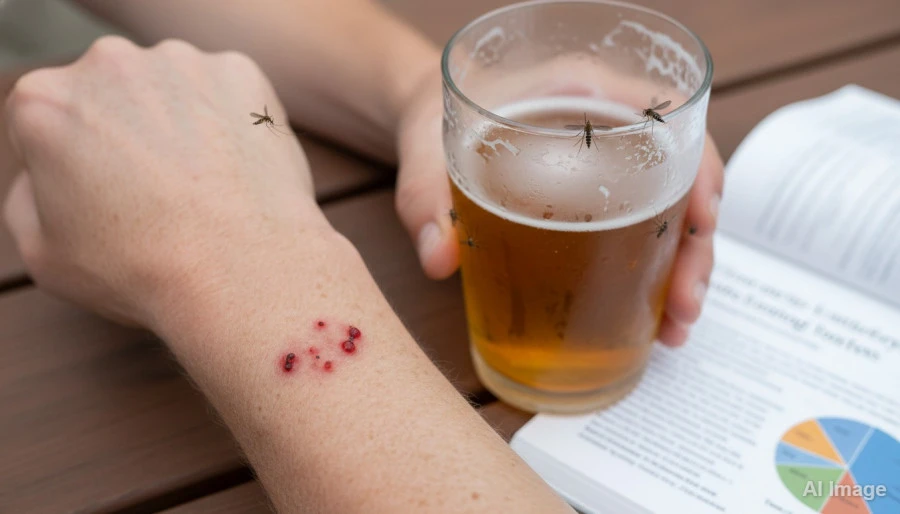
During warm summer nights, avoiding mosquito bites often feels like an endless battle. You might have noticed that in a group of friends, mosquitoes tend to target specific individuals more than others. While many dismiss this as having 'sweet blood,' scientists have now uncovered a fascinating scientific reason behind this phenomenon. According to new research, people who drink beer may become Notably more attractive to mosquitoes. This suggests that if you find yourself being targeted by mosquitoes after a party, it might not just be bad luck, but rather the biological changes triggered by beer consumption.
The Radboud University Experiment
Scientists from Radboud University in the Netherlands conducted an extensive study to investigate this behavior. The research team observed approximately 500 participants and thousands of mosquitoes during a music festival. To ensure controlled conditions, they set up a specialized mobile laboratory, while participants were asked to place their hands inside a specially designed box containing mosquitoes. These boxes featured tiny perforations that allowed the mosquitoes to sense the scent of the human skin without actually being able to bite. High-definition cameras were used to record and analyze which individuals the mosquitoes were most attracted to and how frequently they attempted to land on them.
Findings: The Beer Attraction Factor
The results of the experiment provided clear evidence of a link between alcohol consumption and mosquito attraction, while 35 times more attractive to mosquitoes compared to those who had not. Researchers believe that drinking beer causes several physiological changes that mosquitoes can easily detect. These changes include a slight rise in body temperature, alterations in the scent of sweat, and variations in the amount of carbon dioxide released through breath. Mosquitoes are highly sensitive to these markers, making beer drinkers an easy target for them.
Key Factors That Attract Mosquitoes
Beyond beer consumption, the study identified several other factors that influence mosquito behavior and attraction levels.
The Science of Mosquito Behavior
The study emphasizes that mosquitoes don't bite randomly; they use sophisticated sensory organs to detect carbon dioxide, heat, and chemical signatures from their hosts. This explains why mosquito bites aren't distributed equally among all people in the same environment, while while the researchers at Radboud University acknowledge that further studies are needed to fully understand every variable, this research strongly suggests that daily habits and dietary choices, such as drinking beer, play a major role in how mosquitoes interact with humans. Edited by Avdhesh Panyuli and published on May 14, 2026, this report sheds light on the intersection of health, lifestyle, and entomology, providing a scientific basis for why some people are mosquito favorites after a night of celebration.