
- India,
- 23-Jun-2026 12:09 PM IST



The Indian stock market is on the verge of witnessing a significant liquidity event as some of the most awaited mega IPOs are preparing to hit the floor. These upcoming public offerings, featuring major corporate giants and tech-driven empires, are expected to draw substantial liquidity from the market. This comes at a time when small retail investors are navigating a landscape filled with caution and anxiety, driven by recent market fluctuations, global geopolitical signals, and persistent concerns regarding valuations, while the success of these large-scale IPOs will serve as a definitive benchmark for the resilience and trust of retail investors in the primary market.
The 7 Billion Dollar Question
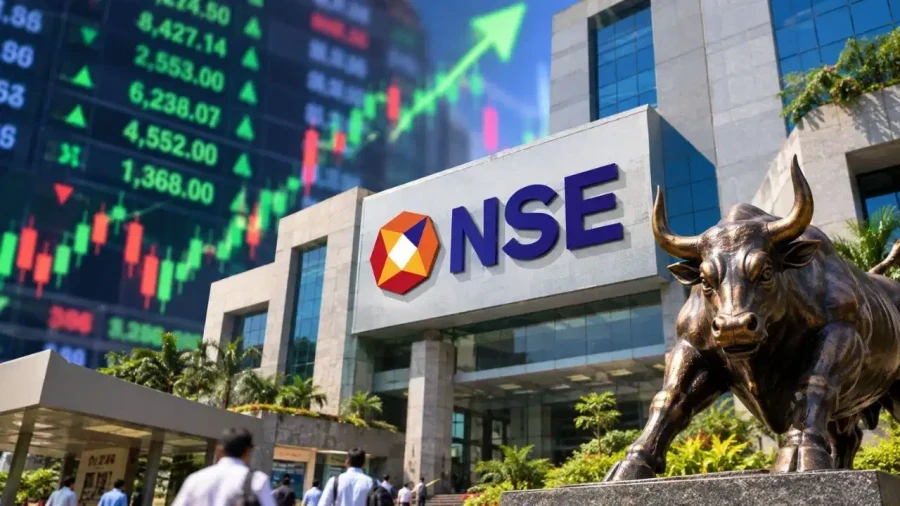
Two of the most significant IPOs on the horizon are Jio Platforms and the National Stock Exchange of India Limited (NSE), both of which are deeply intertwined with the sentiment of retail investors. The central question currently facing the market is whether the strong connection between these entities and the investing public will remain intact. According to trends in the grey market, the 3 billion dollar IPO of NSE and the 4 billion dollar debut of Mukesh Ambani's telecom and digital media empire, Jio Platforms, are generating immense interest. Local investors are searching for the kind of excitement and growth potential that has been largely missing from the secondary market in recent times.
Global Context and Market Performance
While global capital has been aggressively chasing the AI semiconductor boom in markets like Taipei and Seoul—leading to a tripling of Korean stocks and a doubling of Taiwanese equities—India's benchmark indices have struggled to find significant momentum over the past two years. The situation was further complicated by the conflict in Iran, which severely impacted the balance of payments for India, a country heavily dependent on energy imports. The resulting sharp depreciation of the Rupee has also acted as a deterrent for foreign capital. However, with the commencement of peace talks between the United States and Iran, attention has shifted back to India's individual share buyers, who are beginning to return after a period of withdrawal.
Similarities Between NSE and Jio Platforms
Both the National Stock Exchange and Jio Platforms hold formidable competitive advantages within their respective sectors. They operate in industries characterized by duopolies, where high regulatory barriers make it extremely difficult for new competitors to enter. The NSE's primary rival is the 151 year old BSE Limited, which currently holds only a 7 percent share in the total cash-equity turnover. On the other hand, Jio Platforms, with its massive base of over 50 crore subscribers and a media empire that dominates cricket broadcasting, stands Notably ahead of its closest competitor, Bharti Airtel Limited. Indian investors are well-acquainted with both brands; as long as capital controls exist in India, local market participants will continue to rely on the NSE for wealth creation. In the telecom space, Jio's influence on data pricing is unparalleled, and even in emerging sectors like satellite broadband, national security considerations may give Ambani an edge over global players like Elon Musk's Starlink or Jeff Bezos's Amazon.
Key Differences and Structural Challenges
Despite their similarities, the two IPOs differ in their structure and objectives. The NSE listing, which faced long delays due to past governance scandals, is structured entirely as an Offer for Sale (OFS) by existing shareholders. In contrast, Jio Platforms intends to raise fresh capital, a portion of which will be utilized to settle approximately 3 billion dollars in debt. In mature markets, the distinction between an OFS and a fresh issue is often seen as a technicality, but in India's current sensitive environment, it carries more weight. Since the NSE listing is an OFS, no new cash will flow into the exchange's treasury. On top of that, the entities reducing their stakes in NSE include foreign giants like Morgan Stanley and Temasek Holdings Private Limited. This creates a risk where the IPO could become an exit route for foreign capital at a time when New Delhi is working hard to attract NRI investments to stabilize the Rupee, while conversely, Jio is positioned as a company attracting new funds. However, for Jio to succeed, the sellers of NSE shares—including Indian banks, insurance companies, and high-net-worth individuals—may need to leave some profit on the table for others. If the pricing is too aggressive and hurts retail investors, the repercussions will extend beyond Ambani's empire, potentially affecting global stakeholders like Sundar Pichai and Mark Zuckerberg.
Global Backers and Future Prospects
Jio Platforms boasts a prestigious list of global supporters, including Alphabet Inc. , and various other sovereign wealth funds. While these investors aren't selling their shares in the IPO, the listing will allow them to record significant gains on their books. 5 billion dollars made six years ago has now grown into an asset worth 10 billion dollars. A successful Jio IPO will also pave the way for Reliance Industries Limited to plan its next major public float for its consumer commerce division. Separating India's largest retail company will require careful execution, as competition in grocery, fashion, and electronics is far more intense than in the telecom sector, making it even more vital to keep retail shareholders satisfied.