
- India,
- 12-Aug-2026 09:16 PM IST



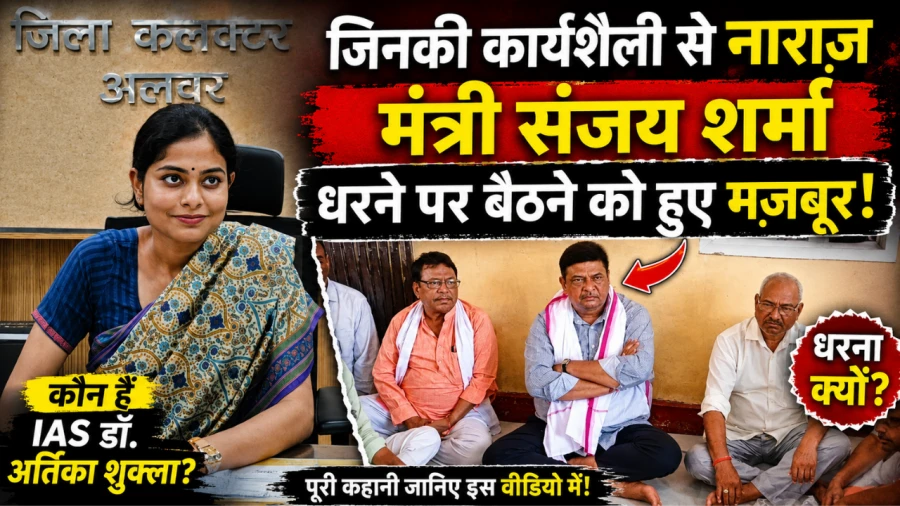
The administrative and political landscape of Alwar district in Rajasthan recently witnessed a significant upheaval. This turmoil was sparked when Sanjay Sharma, the Minister of State for Forest and Environment (Independent Charge) in the Rajasthan Government, took the unprecedented step of sitting on an indefinite protest. The Minister staged this demonstration within the premises of the Municipal Corporation office of his own government, alongside sanitation workers. The core of this dispute lies in the recruitment process for sanitation worker candidates dating back to the year 2012. This particular case had been languishing for several years despite clear judicial interventions. Even after a fresh court order was issued two days prior, the Municipal Corporation Commissioner Sohan Singh Naruka and the district administration failed to issue appointment letters to the selected candidates. This administrative delay triggered a sharp reaction from Minister Sanjay Sharma, who directed his frustration towards the District Collector, Dr. Artika Shukla.
The Standoff Between the Minister and the Collector
During this high-drama event, Minister Sanjay Sharma raised serious questions regarding the working style of District Collector Dr. Artika Shukla. He publicly accused her of "stubbornness" and administrative negligence. The Minister shared a specific instance where he attempted to resolve the matter by speaking with the Collector. According to his statement, when he requested her presence to address the grievances of the workers, Dr. Artika Shukla cited pain in her hand as a reason for her inability to reach the spot. The Minister expressed his deep dissatisfaction with this response, stating that if the Collector was physically unable to attend, she should have at least issued immediate instructions to the Municipal Corporation Commissioner to release the joining letters. This public confrontation has made Dr. Artika Shukla, a prominent IAS officer of the 2016 batch, a central figure of discussion across the political circles of Rajasthan.
Early Life and Family Background of Dr. Artika Shukla
Born on September 5, 1990, in the holy city of Varanasi (Kashi), Dr. Artika Shukla comes from a family with a strong academic and administrative foundation. Her father, Dr, while brijesh Shukla, is a well-known physician and has served as the former secretary of the Indian Medical Association (IMA). Her mother, Leena Shukla, is a homemaker, while artika isn't the only one in her family to serve in high administrative positions. Her eldest brother, Gaurav Shukla, is an IAS officer from the 2012 batch. Her second brother, Utkarsh Shukla, is serving in the Indian Railway Traffic Service (IRTS). This environment of public service played a crucial role in shaping her career aspirations.
Educational Journey: From Medicine to Civil Services
Dr. Artika Shukla completed her early education at St. John's School in Varanasi, while following her school years, she pursued a career in medicine and earned her MBBS degree from the prestigious Maulana Azad Medical College (MAMC) in Delhi. After completing her internship at Lok Nayak Hospital in Delhi, she moved to the renowned PGIMER in Chandigarh to pursue an MD in Pediatrics. However, inspired by her brother's journey in the civil services, she made the bold decision to leave her medical specialization midway. She chose to pivot towards the Union Public Service Commission (UPSC) examinations, a move that would eventually redefine her professional identity.
A Remarkable Achievement in UPSC
The success of Dr. Artika Shukla in the civil services examination is often cited as an inspiration. She appeared for the UPSC Civil Services Examination in 2015 and achieved an extraordinary feat by securing All India Rank 4 in her very first attempt. What makes her achievement even more notable is that she didn't enroll in any formal coaching institute, while instead, she relied on self-study and the guidance provided by her brothers. She chose Medical Science as her optional subject, leveraging her academic background to secure a top position in one of the world's toughest competitive exams.
Personal Life and Professional Milestones
During her administrative training at the Lal Bahadur Shastri National Academy of Administration (LBSNAA), Artika met Jasmeet Singh Sandhu, who had secured All India Rank 3 in the same 2015 UPSC examination. Their friendship eventually led to marriage in 2017. Jasmeet Singh Sandhu is also a senior IAS officer currently serving in the Rajasthan cadre. Also, Dr. Artika Shukla is known to be a very close friend of Tina Dabi, the celebrated topper of the 2015 UPSC batch. In her professional career as a 2016 batch IAS officer, Artika has held several key positions. She started as an SDO in Ajmer and later served as the Additional Commissioner in the Commercial Tax Department in Jaipur and Joint Secretary in the Energy Department of the Rajasthan Government. She also had the distinction of being the first Special Officer (OSD) and subsequently the first District Collector of the newly formed Dudu district. In September 2024, she was appointed as the District Collector of Alwar, and in November 2025, she was given additional charge of the neighboring Khairthal-Tijara district.
Innovations and the Current Controversy
As the Collector of Alwar, Dr. Artika Shukla introduced the 'Vidya Kunj' project, which received widespread acclaim across Rajasthan. This initiative focused on developing open-air park libraries within public parks to encourage reading habits among children and citizens. However, the current friction with Minister Sanjay Sharma has cast a shadow over the administrative proceedings. The Minister emphasized that when both the government and the court intend to provide rights to eligible youth, the bureaucracy shouldn't create hurdles. The sight of a cabinet minister protesting on the streets highlights a significant gap between the bureaucracy and elected representatives. The state government's future course of action regarding the Alwar administration and the role of the Collector remains a subject of intense public interest.